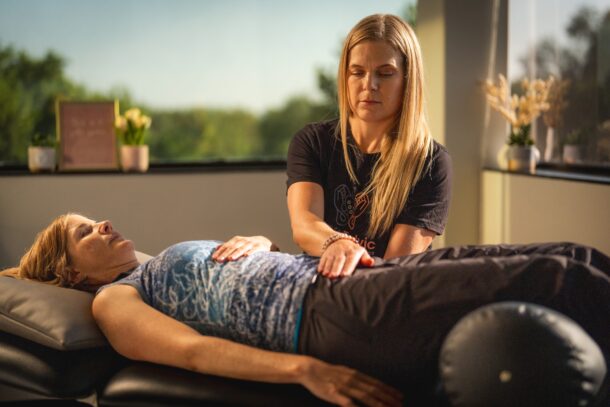
What to Expect at Your Pelvic Health Initial Assessment
Less uncertainty. More clarity.
Starting pelvic floor physical therapy can feel like a big step, especially if you aren’t sure what happens during that first appointment, or you haven’t experienced this kind of treatment before. We’re here to make it feel a little less intimidating.
Your initial assessment is an opportunity to tell your story, learn what’s happening in your body, and work with a provider who genuinely wants to help you feel better. We’ll take the time to understand your symptoms, assess how your body moves and functions, and create a personalized plan based on your needs and goals.
You don’t need to know all the answers before you come in for your first session. That’s what we’re here for.
What is a pelvic health initial assessment?
More than just an evaluation. It’s where we start connecting the dots.
A pelvic health assessment is a comprehensive, one-on-one appointment with your physical therapist to better understand how your pelvic floor, core, hips, spine, breathing, and the rest of your body work together.
Your pelvic floor plays an important role in so much more than you might realize. From bladder and bowel function to intimacy, pregnancy recovery, movement, and everyday activities, these muscles and surrounding tissues are connected to how you feel and function.
Rather than focusing on one symptom in isolation, we look at the bigger picture.
We’ll explore what’s bothering you, what might be contributing to it, and how we can help you work toward the things you want to do without discomfort, limitations, or uncertainty.

What to expect during your first visit
Here’s how we’ll spend our time together.
Your initial assessment is personalized to you. Depending on your symptoms, health history, and goals, your appointment may include a combination of any or all of the following. Not every assessment looks the same, and your provider will guide you through what’s most appropriate for your needs, explaining each step along the way.
We get to know you and your story
We start with a conversation. We want to hear your story, understand your concerns, and learn what brought you to Uplift.
We’ll discuss things like:
-
Your current symptoms and when they started
-
Your medical and health history
-
Pregnancy, birth, postpartum, or surgical history when relevant
-
Your daily activities, fitness routine, and movement habits
-
Sleep, nutrition, hydration, and stress
-
Your goals, concerns, and what you’d love to get back to doing
Nothing is too small or too silly to bring up. The more we understand about you, the better we can personalize your care.
We look at how your body moves and works together
Your pelvic floor doesn’t work alone. We look at the surrounding systems that support it and how they coordinate during everyday movement.
Depending on your needs, this may include:
-
Posture and alignment, from your feet and pelvis to your spine and head
-
Hip and glute strength and mobility
-
Spinal and pelvic movement
-
Breathing patterns and diaphragm movement
-
Core activation and coordination
-
Functional movements like squatting, balancing, and changing positions
We may also explore how your body manages pressure during activities such as lifting, exercising, getting out of bed, or picking up your little one.
We explore your breathing and core connection
Here’s something many people don’t realize: your core is much more than your abdominal muscles!
Your deep core system includes your diaphragm, transverse abdominis, pelvic floor, and deep spinal muscles. These structures coordinate to support your body, manage pressure, and help you move.
Your provider may assess how you breathe, activate your core, and coordinate these muscles together.
We’ll help you understand what your body is doing, what it should be doing, and how those patterns may relate to your symptoms.
We'll discuss an internal assessment
A more specific assessment of your pelvic floor may help your provider understand muscle tension, tenderness, strength, coordination, tissue mobility, and how well your muscles can relax.
Depending on your symptoms and what is appropriate for your care, this may involve an external assessment and/or an internal pelvic floor assessment.
An internal assessment can allow your provider to evaluate things like:
-
Pelvic floor muscle strength and endurance
-
Muscle tension, tenderness, and sensitivity
-
Your ability to contract and fully relax your muscles
-
Tissue mobility and restrictions
-
How your pelvic floor responds when you activate your core
This can be particularly helpful for concerns such as pelvic pain, painful intercourse, urinary symptoms, or pelvic organ prolapse.
A few important things to know:
-
An internal assessment is not automatically part of every initial visit.
-
It is only performed when clinically appropriate and with your informed consent.
-
You can ask questions, decline, or change your mind at any time.
-
Your provider will explain what they’re doing and why before proceeding.
We want you to feel comfortable, informed, and in control throughout your appointment.
Exploring how your surrounding tissues are moving
Your pelvic health is influenced by more than just muscles. Connective tissue, fascia, and the structures surrounding your pelvis and abdomen can also play a role in how your body feels and functions.
When appropriate, your provider may assess:
-
Abdominal tissue mobility and fascial restrictions
-
Pelvic alignment and movement
-
Sacrum, tailbone, and surrounding ligaments
-
Tissue mobility around the bladder and other pelvic organs
These assessments help us better understand the bigger picture and identify areas that may be contributing to your symptoms.
We'll put the pieces together and make a plan
Now that we have identified what’s going on, it’s about figuring out what to do next.
Based on what we learn together, your provider will explain their findings, answer your questions, and begin building a personalized treatment plan.
You leave with:
-
Exercises or movement strategies to start practicing at home
-
Breathing and core coordination techniques
-
A better understanding of what may be contributing to your symptoms
-
Recommendations for what to focus on during future visits
-
A roadmap for working toward your personal goals
Our goal is for you to leave feeling informed, supported, and excited about what’s possible.
What will I actually gain from my first appointment?
By the end of your appointment, we want you to:
Understand your body better
Learn how your pelvic floor, core, breathing, and surrounding structures work together.
Connect the dots
Better understand how your symptoms may relate to your body’s movement patterns, muscle coordination, and overall health.
Know what to work on
Walk away with practical strategies and a starting point for making progress.
Feel supported and empowered
Have a provider who listens, understands your concerns, and works alongside you toward your goals.
More clarity. More confidence. A plan that makes sense for you.

A few questions you might be wondering about
Q: What if I’m postpartum?
Your postpartum assessment follows the same comprehensive, individualized approach, with additional attention to how your body is recovering and adapting to everyday demands.
We may explore:
-
Abdominal and pelvic floor muscle coordination
-
Core strength and pressure management
-
Breathing and bracing strategies
-
Transitions like getting out of bed, sitting up, and lifting
-
Hip and pelvic mobility and strength
-
Your readiness to return to exercise, running, lifting, or other activities
Most importantly, we’ll talk about what you want to get back to doing. Whether that’s picking up your baby without discomfort, returning to the gym, running again, or simply feeling more like yourself, we’ll build a plan around your recovery and goals.
Q: Do I have to have an internal pelvic floor exam?
No! An internal assessment is not required to receive pelvic floor physical therapy. It is one possible tool your provider may recommend to better understand your symptoms. It will only happen with your informed consent, and you can decline or change your mind at any time. We can still learn a lot about your body through external assessments, movement, and conversation.
Q: Is pelvic floor physical therapy painful?
Some areas may be sensitive or tender, particularly if you’re experiencing pelvic pain, but your provider will communicate with you throughout the appointment and adjust the assessment to your comfort level. You are always in control.
Q: What should I wear?
Wear something comfortable that allows you to move easily. We’ll be looking at things like posture, squatting, balance, and other functional movements, so comfortable clothing is ideal.
Q: How long is the initial assessment?
Your initial assessment is a comprehensive appointment, giving your provider time to hear your story, evaluate your needs, and begin building your plan. Our assessments are a 1-hour appointment with your pelvic floor physical therapist. We recommend arriving a few minutes early to find our clinic, and may need a few extra minutes afterwards for scheduling.
Q: Do I need a referral?
No, you do not need a referral or a medical diagnosis to begind pelvic floor therapy with us.